
Over the last 50 years, our research has kept us at the forefront of the cutting-edge science behind stem cell transplants – and we won’t stop until all patients who need a stem cell transplant can survive and thrive.
Our research covers a broad spectrum from in-depth genetic science to innovative new cell therapies and patient-reported quality of life studies.
Our role in facilitating stem cell transplants across the globe means we implement these findings directly into our work, ensuring patients and donors benefit faster.
In order to have the most impact for patients, our work focuses on three areas:
- Survival - To transform outcomes for every transplant patient
- Equity - To achieve greater equity of access, experience and outcomes
- Progress - To contribute to the development of new cell and gene therapies
It’s our aim to improve access, equity and outcomes for every patient who needs a transplant. And by outcomes, we don’t just mean survival – we mean quality of life too. Despite all our progress, too few patients survive and too many suffer complications. We must do better, and we must do more. By working together and uniting our partners across research and healthcare, we will promote collaboration, drive progress and innovation, and bring new hope to more patients.
Chief Medical and Scientific Officer, Dr Robert Danby
Our research teams
Our teams of world-class researchers lead projects across multiple disciplines, bringing together our expertise in bioinformatics, genetics, cell biology, clinical care and more.
Our Immunotherapy team
Immunotherapy harnesses the power of our immune system to tackle disease – cancer in particular. Our Immunotherapy team aims to use the power of immunotherapy to improve the outcomes of stem cell transplants, and develop exciting new cell therapies that could be the treatments of the future.
Our Bioinformatics team
Bioinformatics utilises computer science, mathematics and biology to address important biological questions. Because of the genetic complexities behind stem cell transplants, the crucial work of our Bioinformatics team underpins not just our research, but also our lifesaving work to match donors with patients. The global genetic resource the IPD-IMGT/HLA Database is managed by this team, supporting transplant science and provision around the world.
Our Immunogenetics team
The Immunogenetics team seeks to understand what genetic and clinical factors contribute to successful stem cell transplants. The long-running Patient/Donor Programme sits within this team, which has significantly influenced the way stem cell transplants are performed around the world, and continues to improve our understanding of what factors contribute to successful transplants.
Our Patient Reported Outcomes Research team
Patients can experience significant challenges to their quality of life after a stem cell transplant or cellular therapy treatment. The Patient Reported Outcomes Research team uses patient reports, qualitative research and other social and behavioural science approaches to better understand the experiences and needs of patients and their caregivers. These insights help to develop ways to improve outcomes – both on an individual level through our support provided by Anthony Nolan’s Patient Services team, and by campaigning for UK-wide policy changes.
Our Clinical Research
The Clinical Research team's work provides us with a better understanding of current treatments and services. This can be anything from analysing the effectiveness of a physiotherapy regime to exploring how new medications can be incorporated into transplant care. Based on feedback from patients and healthcare professionals, we can determine what is working well and where improvements can be made.
Our Donor Research
Donor research at Anthony Nolan means finding ways to improve donor availability, experience and safety, as well as outcomes for patients by making donating easier and more efficient. We work closely with donors and cell collection teams to implement new strategies and gather donor perspectives.
Our Histocompatibility & Immunogenetics (H&I) Laboratory
The scientists at our H&I Laboratory process blood samples from donors and patients as part of our donor recruitment and selection processes. They also perform research into new technologies and systems that could improve the way we provide these services, and wider services to the clinical and research communities.
Our research leaders
The quality of our research owes itself in part to the world-leading experts at the head of our research teams. Our research leaders are internationally recognised scientists and clinicians who have long careers of making significant contributions to stem cell transplant research.
Dr Robert Danby
Chief Medical and Scientific Officer
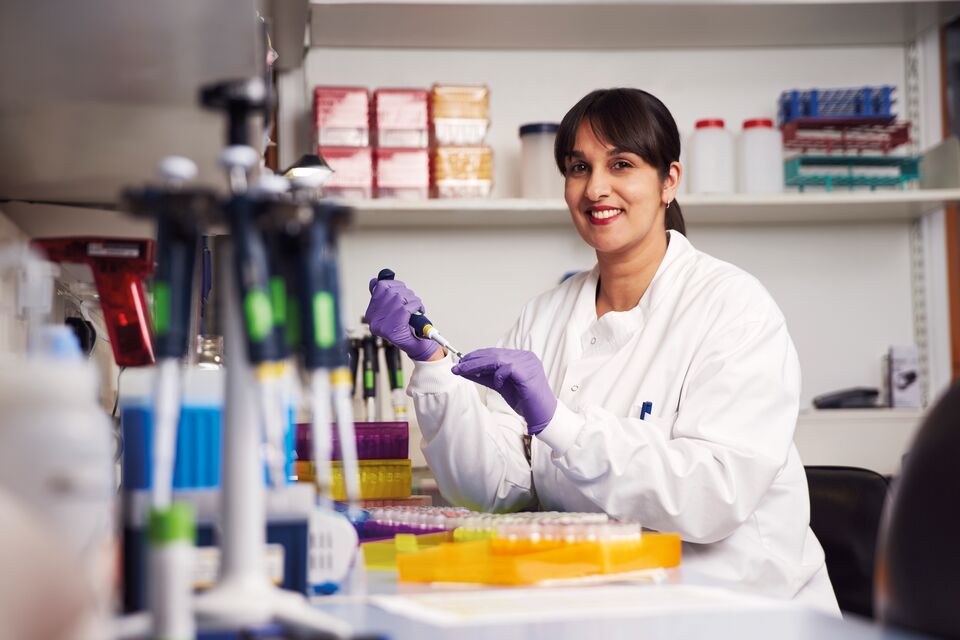
Dr Neema Mayor
Director of Immunogenetics and Research Services
Dr James Robinson
Director of Bioinformatics Research
Dr Diana Hernandez
Director of Immune and Advanced Therapies
Dr Gemma Pugh
Head of Patient Reported Outcomes Research
Our research hubs
We perform research at Anthony Nolan across our major sites and in transplant centres across the country.
The Anthony Nolan Research Institute (ANRI)
ANRI was constructed in 1996 and hosts several of our research teams, housing many long-running projects including our influential Patient/Donor Programme. ANRI is near our head office in Hampstead, London.
Histocompatibility and Immunogenetics (H&I) Laboratory
Next door to ANRI sits our H&I Laboratory. Here, blood samples from donors and patients are analysed as part of our donor recruitment and selection processes. The H&I Labs also perform research into new technologies and systems that could improve the way we provide these services.
Cell Therapy Centre (CTC)
In Nottingham, our CTC hosts our cord blood bank, where donated umbilical cord blood is processed and stored for both transplant and medical research. The CTC performs research into new techniques and approaches that could enhance their work.